In this section, you will:
Consider the rational function
The function can be factored as follows:
Does this mean the function
is the same as the function
The answer is no. Function
does not have
in its domain, but
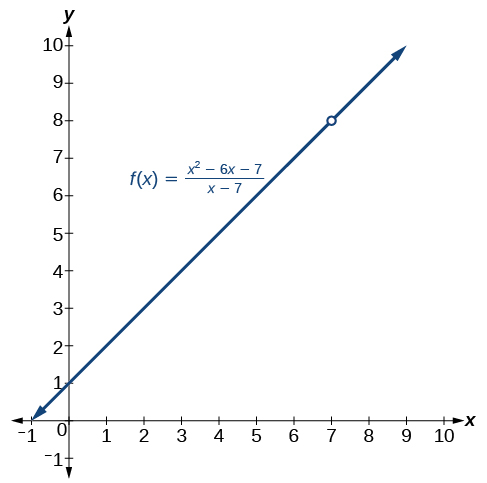
does. Graphically, we observe there is a hole in the graph of
at
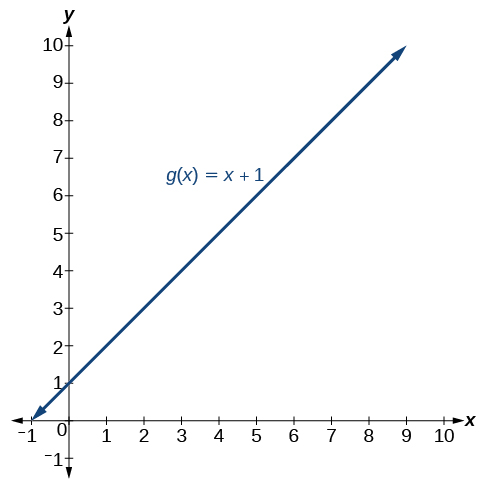
as shown in [link] and no such hole in the graph of
as shown in [link].
So, do these two different functions also have different limits as
approaches 7?
Not necessarily. Remember, in determining a limit of a function as
approaches
what matters is whether the output approaches a real number as we get close to
The existence of a limit does not depend on what happens when
equals
Look again at [link] and [link]. Notice that in both graphs, as
approaches 7, the output values approach 8. This means
Remember that when determining a limit, the concern is what occurs near
not at
In this section, we will use a variety of methods, such as rewriting functions by factoring, to evaluate the limit. These methods will give us formal verification for what we formerly accomplished by intuition.
Graphing a function or exploring a table of values to determine a limit can be cumbersome and time-consuming. When possible, it is more efficient to use the properties of limits, which is a collection of theorems for finding limits.
Knowing the properties of limits allows us to compute limits directly. We can add, subtract, multiply, and divide the limits of functions as if we were performing the operations on the functions themselves to find the limit of the result. Similarly, we can find the limit of a function raised to a power by raising the limit to that power. We can also find the limit of the root of a function by taking the root of the limit. Using these operations on limits, we can find the limits of more complex functions by finding the limits of their simpler component functions.
Let
and
represent real numbers, and
and
be functions, such that
and
For limits that exist and are finite, the properties of limits are summarized in [link]
| Constant, k | |
| Constant times a function | |
| Sum of functions | |
| Difference of functions | |
| Product of functions | |
| Quotient of functions | |
| Function raised to an exponent | whereis a positive integer |
| nth root of a function, where n is a positive integer | |
| Polynomial function |
Evaluate
Evaluate the following limit:
26
Not all functions or their limits involve simple addition, subtraction, or multiplication. Some may include polynomials. Recall that a polynomial is an expression consisting of the sum of two or more terms, each of which consists of a constant and a variable raised to a nonnegative integral power. To find the limit of a polynomial function, we can find the limits of the individual terms of the function, and then add them together. Also, the limit of a polynomial function as
approaches
is equivalent to simply evaluating the function for
.
Given a function containing a polynomial, find its limit.
.
Evaluate
Evaluate
59
Evaluate
Evaluate the following limit:
10
When a limit includes a power or a root, we need another property to help us evaluate it. The square of the limit of a function equals the limit of the square of the function; the same goes for higher powers. Likewise, the square root of the limit of a function equals the limit of the square root of the function; the same holds true for higher roots.
Evaluate
We will take the limit of the function as
approaches 2 and raise the result to the 5th power.
Evaluate the following limit:
**If we can’t directly apply the properties of a limit, for example in
, can we still determine the limit of the function as
approaches
?**
Yes. Some functions may be algebraically rearranged so that one can evaluate the limit of a simplified equivalent form of the function.
Finding the limit of a function expressed as a quotient can be more complicated. We often need to rewrite the function algebraically before applying the properties of a limit. If the denominator evaluates to 0 when we apply the properties of a limit directly, we must rewrite the quotient in a different form. One approach is to write the quotient in factored form and simplify.
Given the limit of a function in quotient form, use factoring to evaluate it.
Evaluate
Factor where possible, and simplify.
When the limit of a rational function cannot be evaluated directly, factored forms of the numerator and denominator may simplify to a result that can be evaluated.
Notice, the function
is equivalent to the function
Notice that the limit exists even though the function is not defined at
Evaluate the following limit:
Evaluate
Find the LCD for the denominators of the two terms in the numerator, and convert both fractions to have the LCD as their denominator.

When determining the limit of a rational function that has terms added or subtracted in either the numerator or denominator, the first step is to find the common denominator of the added or subtracted terms; then, convert both terms to have that denominator, or simplify the rational function by multiplying numerator and denominator by the least common denominator. Then check to see if the resulting numerator and denominator have any common factors.
Evaluate
Given a limit of a function containing a root, use a conjugate to evaluate.
form, evaluate directly.
are conjugates.
Evaluate
When determining a limit of a function with a root as one of two terms where we cannot evaluate directly, think about multiplying the numerator and denominator by the conjugate of the terms.
Evaluate the following limit:
Evaluate
Multiplying by a conjugate would expand the numerator; look instead for factors in the numerator. Four is a perfect square so that the numerator is in the form
and may be factored as
Evaluate the following limit:
Given a quotient with absolute values, evaluate its limit.
Evaluate
The function is undefined at
so we will try values close to 7 from the left and the right.
Left-hand limit:
Right-hand limit:
Since the left- and right-hand limits are not equal, there is no limit.
Evaluate
Access the following online resource for additional instruction and practice with properties of limits.
Give an example of a type of function
whose limit, as
approaches
is
If
is a polynomial function, the limit of a polynomial function as
approaches
will always be
When direct substitution is used to evaluate the limit of a rational function as
approaches
and the result is
does this mean that the limit of
does not exist?
What does it mean to say the limit of
as
approaches
is undefined?
It could mean either (1) the values of the function increase or decrease without bound as
approaches
or (2) the left and right-hand limits are not equal.
For the following exercises, evaluate the limits algebraically.
6
6
does not exist
1
6
1
1
does not exist
For the following exercise, use the given information to evaluate the limits:
For the following exercises, evaluate the following limits.
0
does not exist; right-hand limit is not the same as the left-hand limit.
2
Limit does not exist; limit approaches infinity.
For the following exercises, find the average rate of change
Find an equation that could be represented by [link].
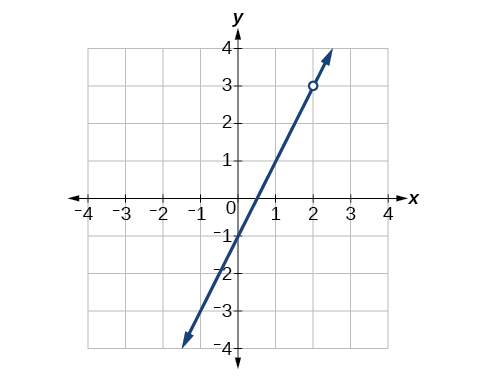
Find an equation that could be represented by [link].
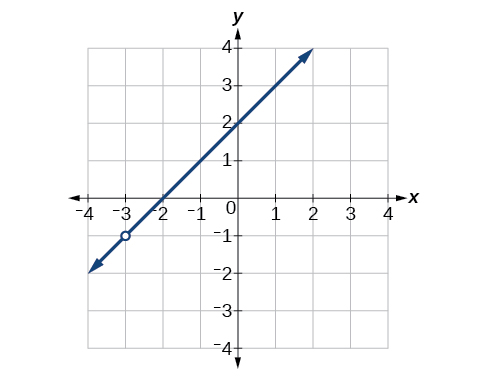
For the following exercises, refer to [link].
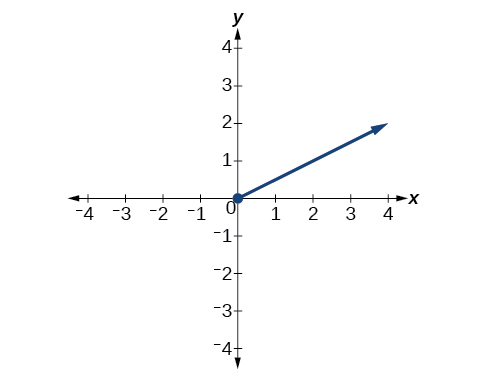
What is the right-hand limit of the function as
approaches 0?
What is the left-hand limit of the function as
approaches 0?
does not exist
The position function
gives the position of a projectile as a function of time. Find the average velocity (average rate of change) on the interval
.
The height of a projectile is given by
Find the average rate of change of the height from
second to
seconds.
52
The amount of money in an account after
years compounded continuously at 4.25% interest is given by the formula
where
is the initial amount invested. Find the average rate of change of the balance of the account from
year to
years if the initial amount invested is $1,000.00.

You can also download for free at http://cnx.org/contents/fd53eae1-fa23-47c7-bb1b-972349835c3c@8.1
Attribution: